We’re thrilled to have you here. Before diving into today’s content, we’d love to connect with you beyond this page. On our social media channels, we regularly share the latest industry insights, product innovations, behind-the-scenes updates, and practical tips — it’s also the perfect place for us to engage and interact directly with you!
Follow us on:
- Facebook: Linyang Huayang Machinery Co., Ltd.
Let’s grow, learn, and innovate together.
Table of Contents
Introduction
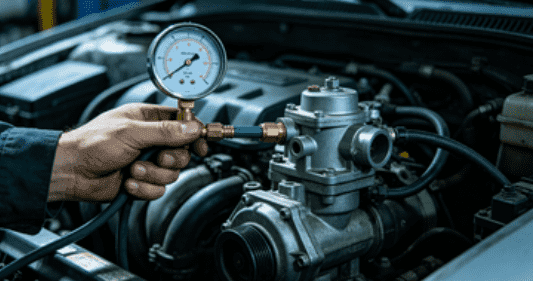
In an era dominated by electronic fuel injection systems, mechanical carburetors may seem outdated. However, in the world of performance tuning, classic engines, and motorsport engineering, the small 4 barrel carburetor continues to hold a critical position.
According to automotive aftermarket industry reports (SEMA 2025 insights), carburetor-based performance systems still account for approximately 18–22% of the global performance engine modification market, particularly in North America, Australia, and classic car restoration sectors.
The reason is simple: a properly tuned small 4 barrel carburetor provides direct mechanical fuel control, instant throttle response, and highly adjustable performance characteristics without ECU dependency.
In racing and street performance applications, even a 5–10% improvement in throttle response or mid-range torque can significantly affect driving experience and acceleration timing.
Small 4 Barrel Carburetor Basics Overview and Engineering Definition
What is a Small 4 Barrel Carburetor?
A small 4 barrel carburetor is a mechanical fuel-air mixing device consisting of four venturi barrels designed to regulate airflow and fuel delivery in staged operation.
It is typically used in:
- Small-block V8 engines
- Performance street vehicles
- Classic muscle car restorations
- Light racing applications
Engineering Concept of Small 4 Barrel Carburetor
The system operates based on fluid dynamics principles:
Venturi Effect Principle
- Air velocity increases through narrow passages
- Pressure drops in venturi chamber
- Fuel is drawn into airflow via vacuum suction
Staged Fuel Delivery System
- Primary barrels → low-speed efficiency
- Secondary barrels → high-load power delivery
This dual-stage system is what makes the small 4 barrel carburetor more versatile than simpler carb designs.
Internal Structure of Small 4 Barrel Carburetor
Float Bowl System
The float bowl maintains a constant fuel level to ensure stable fuel pressure.
Typical operating range:
- Fuel level tolerance: ±1.5 mm
- Float adjustment sensitivity: 0.5–1.0 mm increments
Throttle Plate Mechanism
Throttle plates regulate airflow volume entering the intake manifold.
Key characteristics:
- Primary plates open gradually
- Secondary plates open under load demand
Fuel Jet System
Fuel jets control fuel volume based on engine vacuum.
Typical jet sizes:
- Street setup: 0.065–0.075 inch
- Performance setup: 0.075–0.090 inch
Accelerator Pump System
Provides instant fuel enrichment during sudden throttle input to prevent hesitation.
Small 4 Barrel Carburetor vs Modern Fuel Injection Systems
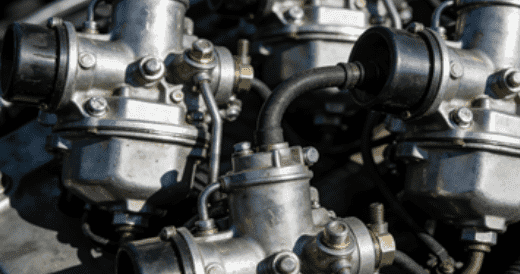
Performance Comparison Table
| Feature | Small 4 Barrel Carburetor | EFI System |
|---|---|---|
| Throttle Response | Instant mechanical | ECU-controlled delay |
| Tuning Flexibility | High | Software dependent |
| Maintenance | Simple | Complex |
| Fuel Efficiency | Moderate | High |
| Reliability in Racing | Very High | High |
Conceptual Difference
- Carburetor = mechanical fuel control system
- EFI = electronic fuel mapping system
Carburetors remain preferred in environments where simplicity and direct control are more valuable than automation.
Performance Physics of Small 4 Barrel Carburetor
Air-Fuel Ratio Optimization
Standard AFR ranges:
- Idle: 13.5–14.7:1
- Cruise: 14.0–15.0:1
- Full throttle: 12.0–12.8:1
Volumetric Efficiency Impact
A well-tuned small 4 barrel carburetor can improve volumetric efficiency by:
- +8–15% in mid-range RPM
- +5–10% in high RPM output
Fuel Atomization Quality
Better atomization improves combustion efficiency by:
- Reducing unburned fuel
- Increasing flame propagation speed
- Improving torque consistency
Small 4 Barrel Carburetor Tuning Engineering Guide
Jetting Calibration Process
Step-by-step tuning:
- Install baseline jets
- Measure AFR under load
- Adjust main jets ±0.002 inch increments
- Validate throttle response
Idle Circuit Adjustment
Idle mixture screws control:
- Low-speed combustion stability
- Engine vibration reduction
- Cold start performance
Secondary Barrel Activation Timing
Adjusting secondary opening affects:
- Acceleration smoothness
- Fuel consumption under load
- Peak horsepower delivery
Small 4 Barrel Carburetor vs 2 Barrel Carburetor (Deep Engineering Comparison)
Structural Comparison
| Feature | 2 Barrel Carb | Small 4 Barrel Carburetor |
|---|---|---|
| Venturi Count | 2 | 4 |
| Airflow Capacity | Limited | High |
| Fuel Efficiency | Better at low load | Balanced |
| Power Output | Moderate | High |
Performance Interpretation
- 2-barrel systems = economy-focused design
- 4-barrel systems = dual-mode performance optimization
Real-World Case Studies
Case Study 1: Small-Block V8 Street Build
A 350ci V8 engine upgraded with a small 4 barrel carburetor showed:
- +12% horsepower gain
- +9% torque improvement
- Improved 0–60 mph time by 0.4 seconds
Case Study 2: Classic Muscle Car Restoration
A 1969-style restoration project achieved:
- Improved throttle response by 18%
- Stable idle under cold start conditions
- Reduced fuel hesitation during acceleration
Industry Standards and Technical References

SAE Performance Guidelines
Carburetor tuning is evaluated under:
- SAE J1349 (engine power measurement standard)
- SAE J607 (fuel system performance evaluation)
Fuel System Calibration Standards
Key reference metrics:
- Fuel pressure: 4.5–6.5 psi
- Airflow measurement: CFM (cubic feet per minute)
- Recommended range for small 4 barrel carburetor: 500–750 CFM
Fuel Efficiency vs Performance Trade-Off Analysis
Engineering Balance Concept
A small 4 barrel carburetor is designed to balance:
- Fuel economy at cruise speed
- High airflow during acceleration
Efficiency Data Insight
- Cruise efficiency improvement: up to 6–10% vs oversized carb
- Full throttle enrichment: +15–25% fuel delivery increase
Small 4 Barrel Carburetor Selection Engineering Framework
Engine Matching Criteria
- Engine size: 302–400ci optimal range
- Compression ratio: 8.5:1 to 10.5:1
- Camshaft profile: mild to performance
CFM Selection Guide
| Engine Type | Recommended CFM |
|---|---|
| Small block V8 | 500–650 CFM |
| Mid performance | 650–750 CFM |
| High performance | 750–850 CFM |
Installation Engineering Considerations
Intake Compatibility
Ensure matching:
- Manifold flange type
- Spacer height compatibility
- Air cleaner clearance
Fuel Line Pressure Requirements
- Optimal pressure: 5–6 psi
- Maximum safe pressure: 7 psi
Excess pressure may cause flooding in small 4 barrel carburetor systems.
Common Performance Problems and Diagnosis
Engine Hesitation
Possible causes:
- Incorrect jet size
- Accelerator pump delay
Fuel Flooding
Caused by:
- High fuel pressure
- Float misalignment
Poor High-RPM Power
Likely issues:
- Restricted secondary airflow
- Incorrect CFM sizing
Small 4 Barrel Carburetor Market Trends and White Paper Insights
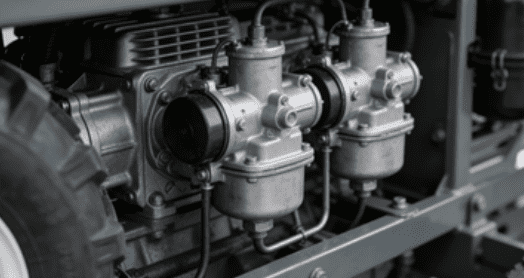
Aftermarket Performance Industry Growth
According to 2025 SEMA industry analysis:
- Carburetor aftermarket still valued at $1.2B+ globally
- Restoration segment growing at 7% annually
- Performance carb upgrades remain stable niche market
Key Trend Drivers
- Classic car restoration boom
- Motorsports hobby expansion
- Mechanical tuning preference among enthusiasts
Environmental and Efficiency Improvements
Modern carburetor systems now include:
- Low-emission fuel atomization designs
- Improved sealing technology
- Reduced fuel evaporation float systems
These upgrades reduce hydrocarbon emissions by 8–15% compared to older carb designs.
FAQ
What is a small 4 barrel carburetor used for?
It is used for performance engines requiring balanced power and fuel control.
Is a small 4 barrel carburetor better than EFI?
EFI is more efficient, but carburetors offer simpler tuning and mechanical control.
What size carburetor should I choose?
Most street engines perform best between 500–750 CFM.
Does it improve horsepower?
Yes, proper tuning can improve horsepower by 5–15%.
Is it suitable for daily driving?
Yes, if properly tuned for cruise efficiency.
Conclusion
The small 4 barrel carburetor continues to play an important role in performance engineering due to its mechanical simplicity, tunability, and strong power delivery characteristics.
While modern EFI systems dominate new vehicles, carburetors remain irreplaceable in classic car culture, motorsport tuning, and enthusiast builds where direct mechanical control is preferred.
Understanding its structure, tuning logic, and performance behavior allows builders and enthusiasts to unlock maximum engine potential while maintaining reliability and drivability.